



Über das Buch
„Wie zerstört man eine Ideologie – oder: F*ck die Nazis!" ist mehr als ein politisches Essay. Es ist persönlich, schonungslos und radikal ehrlich.
Das Buch blickt auf das aktuelle krisengeschüttelte Europa – und zieht Parallelen zur Geschichte: dem Zerfall der Römischen Republik unter Julius Cäsar, dem Aufstieg Napoleons nach der Französischen Revolution, Deutschland 1930. Die Muster wiederholen sich. Und es wird spürbar: Auch heute stehen wir an einem Scheideweg.
Doch wer die Krise versteht, kann auch die Antwort gestalten. Das Buch entwirft eine konkrete Vision – von einem starken, vereinten Europa. Nicht als Utopie. Als Ansporn.
Und es endet mit einem Aufruf zum Mikro-Aktivismus: Jeder von uns kann etwas beitragen. Jede Stimme zählt. Gemeinsam sind wir viele.
Dieses Buch zerstört nicht nur eine Ideologie. Es schafft eine neue – mit europäischem Stolz.
Autor: Timon Lutz
Titel: Wie zerstört man eine Ideologie – oder: F*ck die Nazis
ISBN: 978-3-03886-089-1
Veröffentlichungsdatum: 09.01.2026
Verlag: Österreichische Literaturgesellschaft (Imprint der Europäischen Verlagsgesellschaften GmbH)
Pressekontakt:
Rodja Smolny
Bösendorferstr. 1/16
1010 Wien
Tel.: 01 205 80 08
About the book
How do you destroy an ideology – or: F*ck the Nazis!" is more than a political essay. It's personal, unflinching, and radically honest.
The book looks at today's crisis-ridden Europe – and draws parallels to history: the collapse of the Roman Republic under Julius Caesar, the rise of Napoleon after the French Revolution, Germany in 1930. The patterns repeat themselves. And it becomes clear: we are standing at a crossroads today as well.
But those who understand the crisis can also shape the answer. The book outlines a concrete vision – of a strong, united Europe. Not as a utopia. As an inspiration.
And it ends with a call to micro-activism: each of us can contribute something. Every voice counts. Together, we are many.
This book doesn't just destroy an ideology. It creates a new one – built on European pride.
Für wen ist dieses Buch?
Dieses Buch ist mehr als Politik. Es ist ein Blick in die Wunden einer Generation. Eine ehrliche Abrechnung mit einem System, das viele zurückgelassen hat. Es ist für alle, die spüren, dass etwas gewaltig schiefläuft – und die den Mut haben, genauer hinzusehen. Zwischen den Zeilen steckt kein Parteiprogramm, sondern echte Erfahrungen, Zweifel, Ängste – und eine gehörige Portion Mut. Mut, etwas zu verändern.
For whom is this book?
This book is more than politics. It’s a look into the wounds of a generation. An honest reckoning with a system that has left many behind. It’s for everyone who feels that something is deeply wrong — and who has the courage to take a closer look. Between the lines, you won’t find a party manifesto — but real experiences, doubts, fears — and a bold dose of courage. Courage to change something.

Für alle, die verstehen wollen, wie Europa an diesen Punkt kommen konnte.
For everyone who wants to understand how Europe got to this point.
Für alle, die wissen wollen, welche Kräfte unsere Demokratie unterwandern.
For everyone who wants to know which forces are undermining our democracy.
Für alle, die verstehen wollen, wie Angst als politisches Instrument eingesetzt wird.
For everyone who wants to understand how fear is used as a political weapon.
Für alle, die einen ehrlichen Blick in die Gefühlswelt einer zerrissenen Generation werfen wollen.
For everyone who wants an honest look into the emotional world of a torn generation.
Für alle, die sich wundern: Ja, das hier ist persönlich.
For everyone wondering: Yes, this is personal.
Was dich im Buch erwartet
Dieses Buch ist kein staubiger Politik-Wälzer – sondern ein Weckruf. Auf rund 250 Seiten erwartet dich eine Mischung aus persönlicher Geschichte, politischer Analyse und ungeschönten Wahrheiten. Es ist verständlich geschrieben, faktenbasiert und trotzdem emotional. Du bekommst keine leeren Phrasen, sondern echte Einblicke – in unsere Zeit, unsere Ängste und unsere Möglichkeiten. Verfügbar als Taschenbuch (Softcover) und als E-Book. Erscheinungstermin: Mitte 2025.
What awaits you in the book
This book isn’t a dusty political tome — it’s a wake-up call. Over the course of roughly 250 pages, you'll find a mix of personal story, political analysis, and unfiltered truths. It’s written in clear, accessible language — fact-based, yet deeply emotional. No empty phrases — just real insight into our time, our fears, and our possibilities. Available as a paperback (softcover) and e-book. Release date: mid-2025.
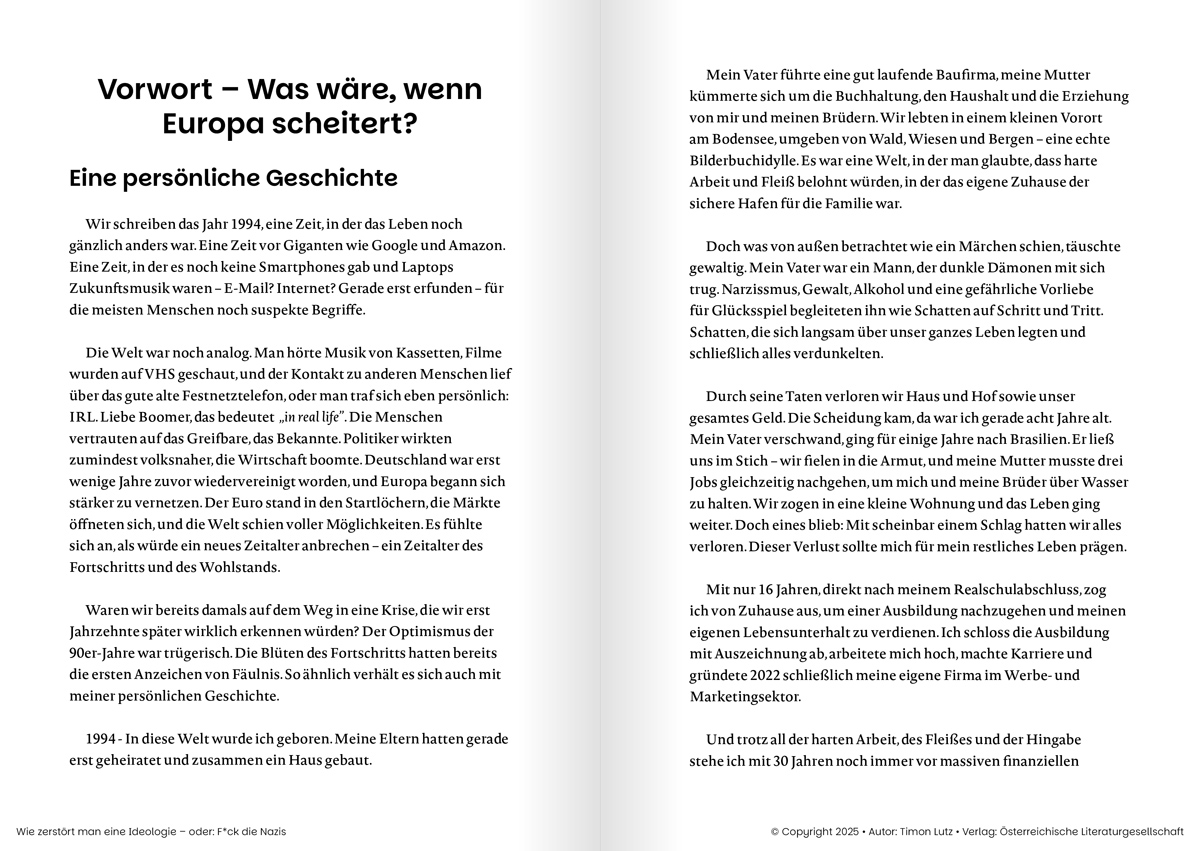
Vorwort – Was wäre, wenn Europa scheitert?
Was als persönliche Geschichte beginnt – die eines Kindes, das in einem traumatischen Umfeld und einem kaputten System aufwächst – mündet in eine unbequeme Frage: Sind wir verloren? Das Vorwort gibt einen intimen Einblick in den Ursprung dieses Buches und bereitet den Boden für eine schonungslose, aber hoffnungsvolle Reise durch Vergangenheit, Gegenwart und Zukunft Europas.
Foreword – What If Europe Fails?
What begins as a personal story — that of a child growing up in a traumatic environment and a broken system — leads to an uncomfortable question: Are we lost? The foreword offers an intimate glimpse into the origins of this book and lays the foundation for a raw yet hopeful journey through Europe’s past, present, and future.
Kapitel 1: Europa in Flammen – Die aktuelle Situation
Wie steht es um Europa im Jahr 2025? Dieses Kapitel beleuchtet die politischen, wirtschaftlichen und gesellschaftlichen Brandherde – und vergleicht sie mit historischen Wendepunkten. Vertrauen schwindet, Spaltung wächst. Doch was sind die tieferliegenden Ursachen der Krise? Und wo stehen wir – historisch betrachtet – wirklich?
Chapter 1: Europe in Flames – The Current Situation
What is the state of Europe in 2025? This chapter sheds light on the political, economic, and social flashpoints — and compares them with historical turning points. Trust is fading, division is growing. But what are the deeper causes of the crisis? And where do we really stand — from a historical perspective?
Kapitel 2: Die Angstmaschine – Kenne deinen Feind
Angst war schon immer ein mächtiges Werkzeug der Macht. Von antiken Tyrannen bis zu modernen Populisten – dieses Kapitel zeigt, wie Angst instrumentalisiert wird, um zu kontrollieren, zu manipulieren und politische Agenden durchzusetzen. Migration, Klimakrise, Inflation – nichts ist zufällig.
Chapter 2: The Fear Machine – Know Your Enemy
Fear has always been a powerful tool of power. From ancient tyrants to modern populists — this chapter reveals how fear is weaponized to control, manipulate, and push political agendas. Migration, the climate crisis, inflation — nothing is random.
Kapitel 3: Wer manipuliert und spaltet? – Die wahren Drahtzieher
Wer profitiert von der Spaltung Europas? Dieses Kapitel blickt hinter die Fassaden der Macht: Lobby-Netzwerke, Großkonzerne, Medienmaschinen – und wie sie mit politischen Akteuren und Plattformen wie TikTok und X ganze Narrative kontrollieren. Wer lenkt wirklich – und wer wird gelenkt?
Chapter 3: Who Manipulates and Divides? – The Real Puppet Masters
Who benefits from a divided Europe? This chapter looks behind the curtain of power: lobbying networks, corporate giants, media machines — and how they collaborate with political actors and platforms like TikTok and X to control entire narratives. Who’s really pulling the strings — and who’s being pulled?
Eine Zwischenbewertung – Wo stehen wir jetzt?
Nach der schonungslosen Analyse der ersten drei Kapitel ist klar: Die Herausforderungen sind real – und tiefgreifend. Doch bedeutet das zwangsläufig den Zusammenbruch? In diesem Zwischenfazit ziehen wir Bilanz: Was steht auf dem Spiel? Warum muss sich Europa neu erfinden? Und was können wir aus den bisherigen Erkenntnissen mitnehmen, um nach vorn zu blicken?
Interim Assessment – Where Do We Stand Now?
After the unfiltered analysis of the first three chapters, one thing is clear: the challenges are real — and profound. But does that automatically mean collapse? This interim reflection takes stock: What’s at stake? Why must Europe reinvent itself? And what can we take from the insights so far to look ahead?
Kapitel 4: Utopie oder machbare Vision? – Ein neues europäisches System
Was, wenn Europa nicht scheitert – sondern über sich hinauswächst? Dieses Kapitel entwirft eine Vision: ein starkes, gerechtes Europa, das sich durch Transparenz, soziale Fairness, Bildung und Eigenständigkeit neu definiert. Utopie? Vielleicht. Aber eine, die möglich ist.
Chapter 4: Utopia or Achievable Vision? – A New European System
What if Europe doesn’t fail — but rises beyond itself? This chapter outlines a vision: a strong, fair Europe, redefined by transparency, social justice, education, and self-reliance. Utopia? Maybe. But one that is possible.
Kapitel 5: Was können wir aktiv tun? – Schritte zur Veränderung
Wie beginnt Wandel? Mit Mut. Dieses Kapitel ist ein Weckruf – gestützt auf historische Vorbilder, auf revolutionäre Bewegungen und praktische Handlungsschritte. Es zeigt, wie jede*r Einzelne Teil einer friedlichen Revolution werden kann. Denn Veränderung beginnt nicht irgendwann. Sie beginnt jetzt.
Chapter 5: What Can We Do? – Steps Toward Change
How does change begin? With courage! This chapter is a call to action — grounded in historical examples, revolutionary movements, and practical steps. It shows how anyone can be part of a peaceful revolution. Because change doesn’t start someday. It starts now.
Leseprobe
Der Anfang einer unbequemen Wahrheit
In der Leseprobe liest du das Vorwort – den Ursprung einer Reise zwischen Zweifel, Wut und der Suche nach Antworten. Es ist der erste Schritt hinein in eine Geschichte, die nicht nur eine persönliche ist, sondern die einer ganzen Generation.
Reading sample
The beginning of an uncomfortable truth
In the reading sample, you’ll find the foreword — the beginning of a journey through doubt, anger, and the search for answers. It’s the first step into a story that is not just a personal one — but the story of an entire generation.
The reading sample is currently only available in German. A professional translation is being worked on.